
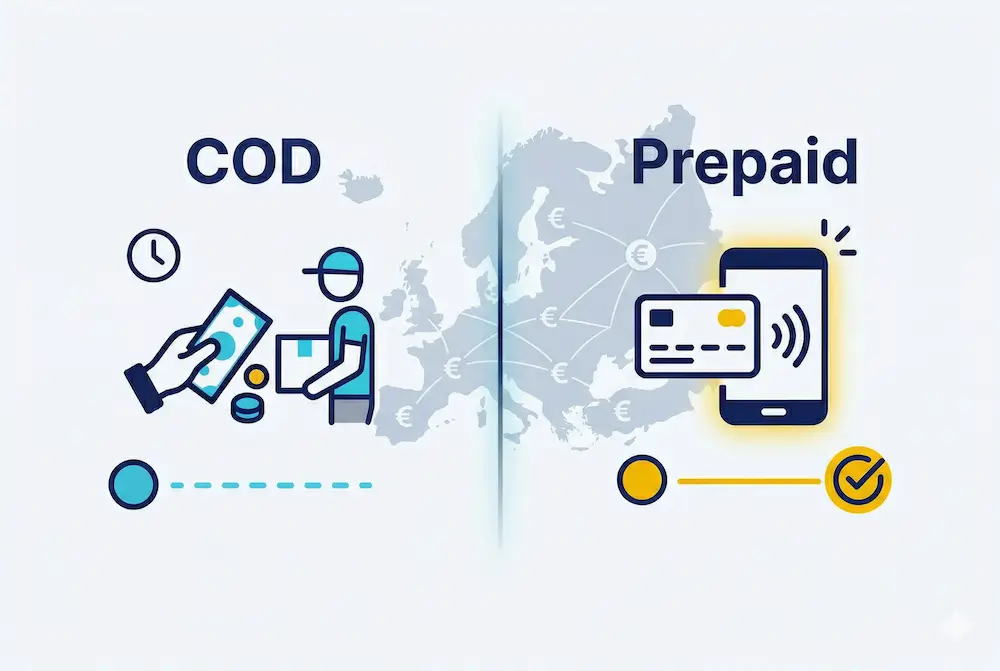
When launching or expanding an e-commerce business in Southern Europe, one of the most consequential decisions is which payment model to offer: cash on delivery (COD), prepaid (credit card, debit card, or digital wallet), or both.
The answer depends on several variables — the product category, the target demographic, the advertising channel, and the operational infrastructure available to the seller. There is no universal right answer, but there is a clear framework for evaluating which model fits a given business, market, and growth stage.
This article compares COD and prepaid payments across the dimensions that matter most to direct-to-consumer e-commerce sellers operating in Spain, Italy, and Portugal.
What Each Model Means Operationally
Before comparing performance, it is useful to define what each model involves at an operational level:
Prepaid (credit card / digital wallet): The customer pays at checkout, before the parcel is dispatched. The seller receives payment immediately (within 1–3 business days via payment processor settlement). If the order is delivered and the customer is satisfied, no further payment steps are needed. If the customer returns the product, a refund must be issued. There are no failed delivery costs from a payment perspective, but charge disputes (chargebacks) are possible.
Cash on Delivery: The customer places an order without paying. The seller’s fulfillment provider dispatches the parcel only after a confirmation call. The carrier collects cash at the door. The fulfillment provider consolidates payments and transfers net proceeds to the seller on a weekly or monthly cycle. Failed deliveries result in zero revenue and absorbed shipping costs.
Conversion Rates: COD Wins in Untrusted Environments
The most consistent advantage of COD over prepaid in Southern European direct-response campaigns is higher conversion rates on landing pages. When consumers see an unfamiliar brand advertising on Facebook or TikTok, requiring them to enter card details and pay upfront creates a significant friction point. Many potential buyers abandon at this stage.
Offering COD removes that friction. The customer has nothing to lose by placing an order — no money leaves their hands until the product is at their door. This dramatically increases the number of orders placed per 1,000 landing page visitors.
Typical conversion rate comparisons from direct-response campaigns in Spain and Italy:
| Scenario | Conversion Rate (approximate) |
|---|---|
| Prepaid-only checkout, new brand | 1.5–3% |
| COD-only checkout, same brand/product | 4–8% |
| Prepaid + COD option offered | 5–9% (combined) |
These figures vary by product, ad quality, and audience, but the directional advantage of COD for first-purchase conversion from cold traffic is well-established and consistently observed across campaigns in Southern European markets.
Revenue Per Order: COD Has a Collection Gap
Prepaid orders generate revenue at checkout. COD orders generate revenue only when successfully delivered and paid. This creates a structural difference in how revenue is recognized and when it arrives:
- Prepaid: Revenue received within 2–3 days of order placement, regardless of delivery outcome
- COD: Revenue received 7–30 days after order placement, only for successfully delivered orders, after deduction of fulfillment fees, shipping, and COD collection charges
The net effective revenue per COD order is therefore lower than per prepaid order, even at the same gross price point, because of delivery failures, logistics fees, and payment delay.
However, because COD generates significantly more orders (due to higher conversion rates), the total revenue from COD campaigns often exceeds prepaid campaigns for the same advertising budget — provided failed delivery rates are managed within acceptable limits.
Cash Flow: Prepaid Is Structurally Superior
From a cash flow perspective, prepaid is unambiguously better. The seller receives money before dispatching inventory. This means:
- No capital tied up in goods-in-transit awaiting cash collection
- No exposure to carrier collection failures
- Faster access to working capital for reinvestment in advertising or inventory
COD creates a cash flow gap: the seller must pay for product sourcing, shipping, and logistics before receiving payment. For fast-growing operations with high order volumes, this gap can require significant working capital financing if not managed carefully.
Sellers scaling COD operations in Spain, Italy, or Portugal should plan for a rolling 30–45 day cash flow cycle, accounting for the time between inventory procurement and receipt of COD transfers.
Operational Complexity: COD Requires More Infrastructure
Prepaid fulfillment is operationally simpler. The order arrives, is verified by the payment processor, and is fulfilled. No confirmation call. No cash collection coordination. No multi-party financial reconciliation.
COD adds operational layers that require specialized logistics infrastructure:
- Call center for pre-dispatch confirmation
- Cash collection agreements with carriers
- Payment reconciliation and transfer reporting
- Return processing for failed deliveries
Sellers who try to run COD logistics using standard fulfillment providers — designed for prepaid e-commerce — typically encounter significant operational failures. COD requires a purpose-built logistics partner.
Risk Profile: Different Risk Types
Both models carry risk, but of different types:
| Risk Factor | COD | Prepaid |
|---|---|---|
| Failed delivery cost | High — full logistics cost absorbed | None — payment received before dispatch |
| Chargeback / fraud | None — cash collected in person | Moderate — card disputes possible |
| Cash flow risk | High — payment delayed | Low — payment immediate |
| Conversion risk | Low — high willingness to order | Higher — friction at checkout |
| Carrier dependency | High — relies on carrier collection | None |
Which Model to Choose?
Choose COD when:
- You are running direct-response advertising to cold traffic in Spain, Italy, or Portugal
- Your brand is not yet recognized by your target audience
- Your product category benefits from low-risk trial (health, beauty, gadgets)
- You have access to a reliable COD fulfillment partner
- Your product margin is sufficient to absorb a 15–25% failed delivery rate
Choose prepaid when:
- You have an established brand with customer trust
- Your customers are high-purchase-intent (e.g., arriving from Google Shopping or branded search)
- Your product has a high price point where COD collection risk is excessive
- You are targeting Northern European markets where COD is not standard
Use both when:
- You want to maximize order volume while offering choice to customers who prefer prepaid
- Your landing page can accommodate a two-option checkout without complexity
- You have the fulfillment infrastructure to handle both workflows
In practice, most successful direct-to-consumer sellers in Southern Europe start with COD-only, validate the product and market, then introduce a prepaid option to serve customers who prefer digital payment — capturing both segments without the prepaid-only conversion penalty.
The Hybrid Approach at Scale
Mature COD sellers in Spain and Italy often operate a hybrid model with deliberate segment targeting:
- Cold traffic from social media ads → COD checkout (maximizes conversion on untrusted traffic)
- Retargeted traffic (customers who visited but did not convert) → COD or prepaid option
- Repeat customers / email subscribers → Prepaid preferred (trust already established)
- High-value products (€80+) → Prepaid only or COD with stricter confirmation requirements
This segmentation approach captures the conversion advantages of COD where they matter most while progressively shifting established customers toward prepaid to reduce logistics complexity and improve cash flow.
Summary
COD and prepaid are not competing models — they serve different customer trust states and market contexts. For sellers entering Southern European markets via social media advertising, COD is typically the superior model for maximizing initial conversion and total order volume. As the business matures and brand recognition grows, introducing prepaid alongside COD captures additional revenue with lower operational overhead. The goal is not to choose one permanently, but to understand when each model creates value and build infrastructure that supports both.