
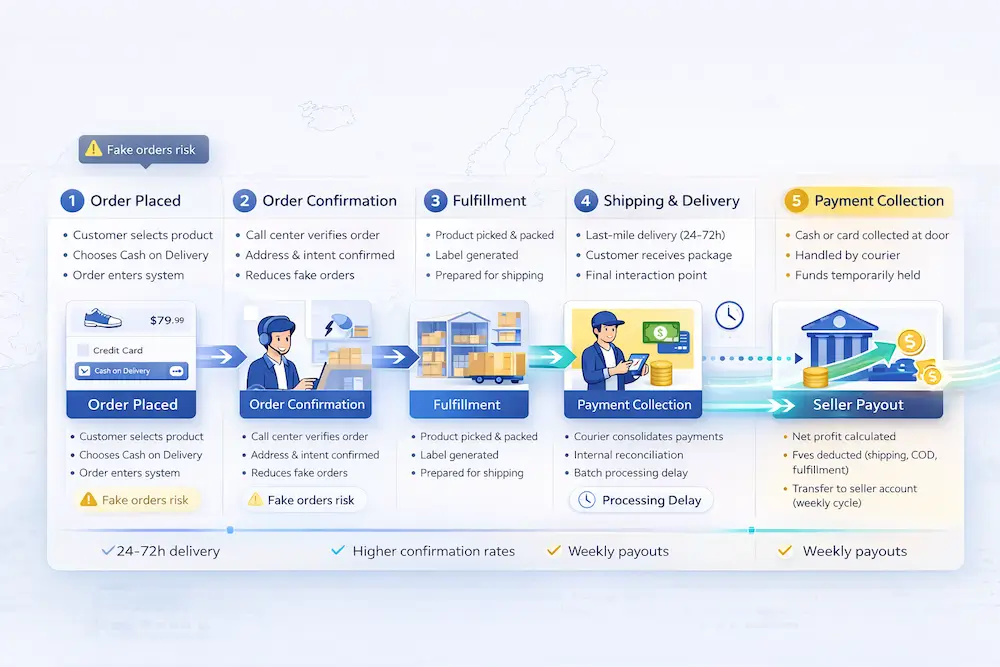
One of the most common questions from sellers entering COD markets is a practical one: once a customer pays cash at the door, how does that money reach my bank account?
The answer involves a multi-step process — carrier collection, cash remittance to the fulfillment provider, deduction of fees, and transfer to the seller — that unfolds over days or weeks. Understanding each step of this cycle is essential for accurate cash flow planning, financial reporting, and running a profitable COD operation.
The COD Payment Chain: Five Links
Cash collected from a European COD delivery passes through five distinct links before it reaches the seller’s bank account:
Link 1 — Customer to Carrier: At the moment of delivery, the carrier’s agent collects the specified cash amount from the customer. The carrier is contractually authorized to collect this amount as stipulated in the COD shipment agreement.
Link 2 — Carrier Internal Consolidation: The carrier consolidates cash collected across all its delivery agents on a daily or weekly basis. These collections are recorded against the corresponding consignment numbers. Carriers batch collections over a period (typically 7–14 days) before remitting to the fulfillment provider.
Link 3 — Carrier Remittance to Fulfillment Provider: On a weekly or biweekly schedule, the carrier transfers all COD collections to the fulfillment provider’s account, accompanied by a reconciliation report listing each consignment number, delivery date, amount collected, and any failed or pending deliveries.
Link 4 — Fulfillment Provider Reconciliation and Deductions: The fulfillment provider reconciles the carrier remittance against orders in its system and deducts: warehousing and storage fees, order fulfillment fees (picking, packing, labeling), confirmation call fees, outbound shipping fees, COD collection service fees, and return processing fees. The remaining balance is the seller’s net proceeds.
Link 5 — Fulfillment Provider to Seller: The fulfillment provider transfers net proceeds to the seller’s registered bank account on the agreed schedule — typically weekly or monthly — accompanied by a detailed financial report.
Transfer Schedule Options: Weekly vs. Monthly
Most COD fulfillment providers offer two transfer schedule options:
Weekly transfers: Net proceeds from the previous week’s delivered orders are transferred at the start of the following week. This provides faster access to cash and is preferable for sellers with high order volumes or tight working capital.
Monthly transfers: All proceeds from the calendar month are consolidated and transferred in a single payment at the beginning of the following month. This simplifies accounting but creates a longer cash gap — sellers may wait up to 5–6 weeks for early-month orders. For sellers in the growth phase needing to reinvest quickly, weekly transfers are generally preferable.
Understanding the Financial Report
Each payment transfer should be accompanied by a detailed financial report covering:
Order summary: Total orders placed, confirmed and dispatched, successfully delivered, failed/returned, and pending delivery.
Revenue section: Gross cash collected per country (Spain / Portugal / Italy) and total gross cash collected.
Deductions section: Warehousing fees, fulfillment fees per order, confirmation call fees, outbound shipping costs, COD collection fees, and return handling costs.
Net proceeds section: Gross collected minus total deductions = net transfer amount, with bank account details and transfer reference.
Sellers should reconcile this report against their own order management records every transfer period. Discrepancies should be raised with the fulfillment provider immediately.
The Cash Flow Gap: Planning for the Delay
The structural reality of COD is that sellers must fund operations before receiving revenue. A typical timeline:
| Day | Event |
|---|---|
| Day 0 | Order placed by customer |
| Day 1 | Confirmation call made |
| Day 2 | Order dispatched from warehouse |
| Day 3–4 | Delivery and cash collection |
| Day 4–11 | Carrier internal consolidation |
| Day 7–14 | Carrier remits to fulfillment provider |
| Day 14–21 | Fulfillment provider processes and deducts fees |
| Day 21–28 | Net proceeds transferred to seller |
For a seller dispatching 100 orders on Day 0, payment arrives approximately 3–4 weeks later. For a seller processing 1,000 orders per month at €40 per order with €18 total costs per order, the typical working capital requirement to cover the rolling payment gap is approximately €15,000–€20,000.
Protecting Against Carrier Collection Errors
COD cash collection is handled by human carriers, and collection errors occur occasionally. Common issues include carriers collecting the wrong amount, marking an order as delivered when it was not, or recording a collection against the wrong consignment number.
To minimize exposure: ensure all COD amounts are printed clearly on parcel labels, cross-reference carrier remittance reports against delivery confirmations, and flag discrepancies to the carrier immediately. A reputable fulfillment provider maintains direct carrier relationships and can escalate collection disputes on the seller’s behalf.
Tax Considerations for COD Revenue
COD revenue represents gross sales revenue subject to standard VAT and income tax obligations. Key points:
- VAT registration: Sellers exceeding the EU VAT registration threshold in Spain, Italy, or Portugal must register for VAT in those countries or use the EU One Stop Shop (OSS) scheme.
- Revenue recognition: For accounting purposes, COD revenue is typically recognized at the point of delivery (when cash is collected), not at the point of order.
- Financial reporting: Detailed reports from the fulfillment provider serve as the primary documentation for revenue recognition and fee deduction in the seller’s accounts.
Summary
The COD payment cycle — from cash collected at the door to net proceeds in the seller’s bank account — typically takes 3–4 weeks and involves carriers, fulfillment providers, and bank systems at each stage. Sellers who understand this cycle can plan working capital accurately, reconcile financial reports confidently, and grow their COD operations without cash flow surprises. Partnering with a fulfillment provider that delivers transparent, detailed financial reporting at each payment cycle is essential for maintaining financial control over a COD business.