
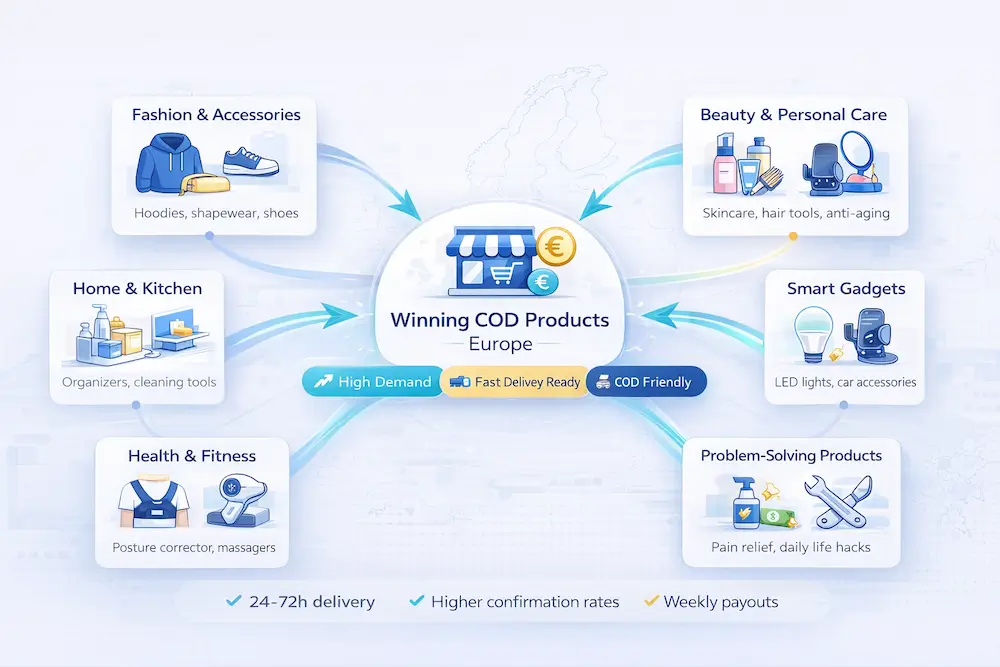
Product selection is one of the most critical decisions in COD e-commerce. The COD model has structural characteristics — a confirmation call before dispatch, a cash payment at the door, and a meaningful failed delivery rate — that make it well-suited to certain product types and fundamentally unsuitable for others.
Sellers who choose products poorly lose money on failed deliveries, return logistics, and wasted advertising spend. Sellers who choose products that align with COD dynamics can build highly profitable direct-to-consumer businesses in Spain, Italy, and Portugal without the brand equity required to compete in prepaid e-commerce.
What Makes a Product Well-Suited for COD?
1. Low-to-mid price point (€15–€80) — COD works best when the purchase decision feels low-risk. Products in this range allow customers to order without upfront payment while leaving the seller enough margin to absorb failed deliveries.
2. Immediately obvious value proposition — COD customers respond to advertising, not search intent. The product must communicate its value in a 15–60 second video with a clear problem-solution narrative.
3. Not available in physical retail stores — Products that cannot be found locally remove the “I can just get it in town” objection.
4. Durable and not easily damaged in transit — COD parcels may be returned and reshipped. Durability reduces return and damage-related losses.
5. Not subject to customer confusion post-delivery — Simple, self-explanatory products reduce post-delivery dissatisfaction and return rates.
Top Performing Product Categories
1. Health and Wellness Products
The strongest and most consistent COD category across Spain, Italy, and Portugal. Consumers experiencing pain or health concerns are motivated buyers who welcome the COD model’s no-upfront-payment approach. High-performing sub-categories include joint and muscle pain relief devices, slimming garments and devices, herbal health supplements, personal massagers, blood pressure monitors, and sleep improvement products.
2. Home and Kitchen Gadgets
Southern European consumers invest heavily in their homes and kitchens. High-performing sub-categories include kitchen organizational systems, innovative cooking tools and appliances at accessible price points, steam cleaners and robotic mops, space-saving furniture accessories, and home security devices. These products have clear demonstrable value and low return rates.
3. Personal Care and Beauty Devices
COD is especially effective for beauty products because consumers are skeptical of purchasing unfamiliar beauty brands without trial. High-performers include facial cleansing and anti-aging devices, IPL and laser hair removal devices, electric facial massagers, nail care gadgets, and teeth whitening kits. Video demonstrations showing visible results drive high engagement.
4. Consumer Electronics Accessories
A high-volume, competitive COD category. High-performers include fast charging cables and adapters, wireless earphones and Bluetooth speakers at €20–€40, power banks, and smart home accessories. Success requires product differentiation or high volume with efficient logistics to maintain margins.
5. Fitness and Outdoor Products
Home fitness products have strong perceived value and sustained demand. High-performing sub-categories include resistance bands, compact home gym equipment, posture correctors, back support products, and portable fitness tracking gadgets.
6. Fashion and Apparel
Works in COD but carries higher return rates, particularly in Italy. Best practice: focus on accessories (scarves, bags, belts) rather than sized clothing, offer limited size ranges with clear sizing guidance, and target specific sub-categories rather than broad fashion.
Product Categories to Avoid in COD
High-value items (€150+): A refused €200 COD parcel is expensive to absorb, and confirmation rates are lower for high-ticket items.
Perishables or temperature-sensitive goods: COD return cycles take days. Food, cosmetics with short shelf lives, and temperature-sensitive products are operationally unmanageable.
Subscription or consumable products: COD is a single-order model and does not support repeat-purchase revenue models without a separate retention mechanism.
Fragile products with high breakage rates: Repeated handling during delivery and return cycles erodes margins rapidly.
Products requiring regulatory approval: Medical devices and certain supplements require advance registration in Spain, Italy, or Portugal before they can be legally sold.
Margin Requirements for COD Product Viability
A practical margin test: product landed cost should be ≤ 25–30% of selling price, with €4–€9 per delivered order for fulfillment and shipping, and a 15–20% failed delivery allowance built into calculations. A €40 product with €8 landed cost, €7 fulfillment/shipping, and €6 advertising cost generates approximately €19 gross profit per delivered order — roughly €11–€13 net per order placed at a 20% failure rate.
Summary
The best COD products in Spain, Italy, and Portugal combine emotional appeal, demonstrable value, accessible price points, and physical durability. Health, home, beauty, and tech accessories are the strongest categories, each supported by structural reasons tied to the COD model’s dynamics. Sellers who validate product-market fit before committing to large inventory orders, and who model their margins honestly with failed delivery allowances, build sustainable and scalable COD businesses.