
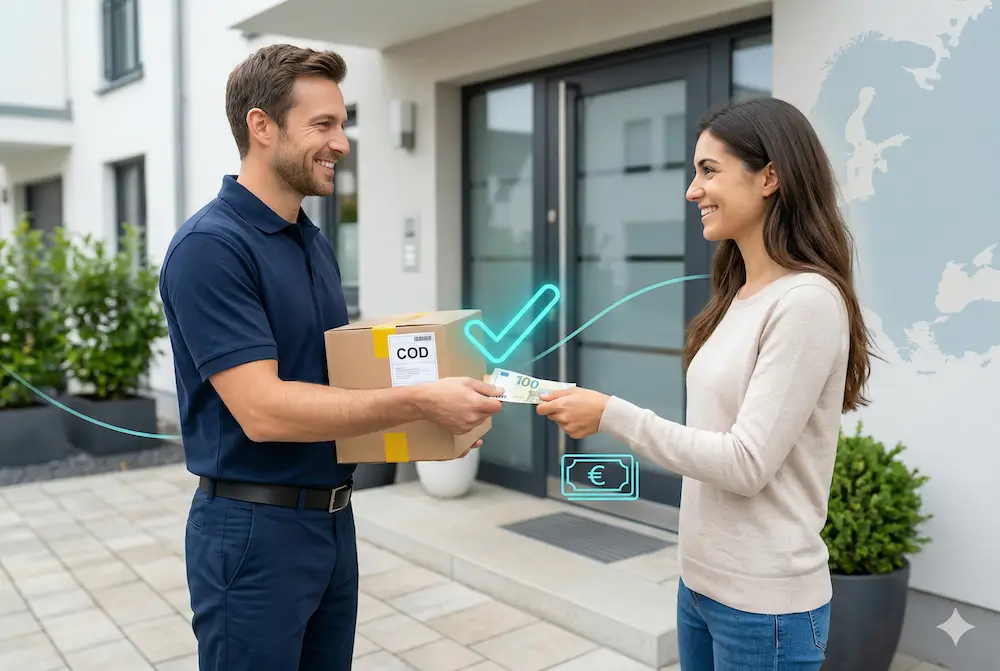
Failed deliveries are the defining cost risk in cash-on-delivery e-commerce. When a COD parcel is dispatched and not successfully delivered — because the customer refuses to pay, is absent at the time of delivery, or gave a false address — the seller absorbs the full cost of outbound shipping, return shipping, and any product handling costs, while receiving zero revenue from that order.
In a well-run COD operation, failed deliveries are unavoidable but manageable. The difference between a profitable COD business and an unprofitable one often comes down to the percentage of dispatched orders that result in successful delivery. A 15% failure rate versus a 25% failure rate can mean the difference between healthy margins and a net loss — particularly at scale.
This guide covers the primary operational levers that reduce failed COD deliveries: pre-dispatch confirmation protocols, address quality checks, carrier selection, and post-dispatch communication strategies.
Why COD Deliveries Fail: The Root Causes
Before addressing solutions, it is important to understand the specific causes of COD delivery failures, because different causes require different interventions:
1. Customer was not home at delivery. The most common reason for a first failed attempt. The customer was away from home when the carrier arrived, or was not expecting the delivery at that specific time.
2. Customer changed their mind. The customer placed the order impulsively — often via a social media ad — and by the time the parcel arrives, no longer wants the product.
3. Customer never intended to pay. A small percentage of COD orders come from consumers who click “order” out of curiosity or as a habit, with no genuine intent to pay. This is more common in markets with low trust-based buying culture and particularly common for low-engagement ad campaigns.
4. Address was incomplete or incorrect. The customer provided an incomplete, ambiguous, or entirely incorrect address. The carrier cannot deliver, and the parcel is returned.
5. Customer could not be reached. The customer provided a non-functioning phone number, was unresponsive on the day of delivery, or could not coordinate with the carrier for re-delivery.
Each of these failure types requires a different intervention in the pre- or post-dispatch workflow.
The Phone Confirmation Call: The Most Effective Single Intervention
Pre-dispatch phone confirmation is the most impactful tool for reducing failed COD deliveries. When a call center agent contacts the customer before the parcel is sent, the call accomplishes several things simultaneously:
- Verifies genuine intent to purchase. Customers who never intended to pay rarely confirm orders by phone. The confirmation call filters out a significant portion of low-quality orders before they consume shipping budget.
- Validates contact information. The call confirms that the phone number works and the customer is reachable — both critical for delivery coordination.
- Verifies and corrects the address. Agents can confirm address details, detect obvious errors, and update incomplete information before dispatch.
- Sets delivery expectations. Customers who have spoken to an agent and confirmed their order are more likely to be home and ready to pay than customers who placed an order without any human interaction.
The quality of confirmation calls has a direct and measurable impact on delivery success rates. Key factors that determine confirmation call effectiveness:
- Call timing: Calls placed within 1–4 hours of order placement achieve the highest pickup rates; calls placed more than 24 hours after ordering see significantly lower engagement.
- Language and accent: Agents should speak the customer’s native language (Castilian Spanish, Italian, European Portuguese) using natural, non-scripted language. Heavy accents or clearly offshore call center speech reduces confirmation rates.
- Call script: The best-performing scripts are brief (60–90 seconds), confirm the order details clearly, verify the address, and provide an estimated delivery date. Lengthy scripts increase hang-up rates.
- Follow-up attempts: If the first call attempt fails, a second attempt should be made 2–4 hours later. A third attempt the following morning can recover additional orders. Beyond three attempts, conversion drops significantly.
Address Quality Checks Before Dispatch
Address errors are responsible for a meaningful proportion of failed deliveries that cannot be resolved by carrier re-delivery attempts. Implementing address quality checks before dispatch catches correctable errors before they become failed deliveries.
Effective address verification measures:
Postal code validation: Cross-reference the customer’s postal code against the city and street they provided. Postal code databases for Spain, Italy, and Portugal are available and can be integrated into order management systems to flag inconsistencies before the confirmation call.
Street and building number checks: Agents on confirmation calls should verify complete address details, including apartment or floor numbers where applicable. Urban addresses in Italy and Spain in particular often require additional details to ensure correct delivery.
Landmark and delivery instruction capture: For rural addresses or areas with informal addressing, asking customers to provide a nearby landmark or specific delivery instructions significantly improves carrier success on the first attempt.
Carrier Selection and Management
Not all carriers perform equally across all regions, and carrier selection has a direct impact on delivery success rates. Key considerations:
First-attempt delivery rate: Carriers vary significantly in how frequently they succeed on the first delivery attempt. Carriers with high first-attempt rates reduce the number of parcels that require re-delivery or return, lowering total logistics cost.
Re-delivery attempts: How many attempts does the carrier make before returning the parcel? A carrier that makes two attempts instead of one can save a meaningful percentage of orders where the customer was simply absent on the first attempt.
SMS and customer notification quality: Carriers that proactively notify customers via SMS or app notification on the day of delivery — with a delivery window — achieve substantially lower absence rates than carriers that provide no advance notice.
Return speed: When delivery does fail, how quickly does the carrier return the parcel to the warehouse? Slow return cycles tie up inventory and delay restocking decisions.
Working with a COD fulfillment provider that has contracts with multiple carriers provides flexibility to route shipments through the best-performing carrier for each destination region.
Post-Dispatch Communication to Improve Delivery Success
Even after a parcel is dispatched, proactive communication can reduce the number of parcels that fail on delivery:
Day-of delivery SMS: A brief SMS message sent on the morning of the expected delivery day — confirming the delivery window and payment amount — has been shown to reduce absence rates by 10–20%.
WhatsApp follow-up (Italy and Spain): In markets with high WhatsApp penetration, sending a WhatsApp message with tracking information and delivery details achieves higher open and response rates than SMS. Customers who know their parcel is arriving are more likely to arrange to be home.
Carrier tracking link: Sending customers a tracking link allows them to monitor their parcel and proactively reschedule if needed, reducing failed first attempts.
Order Filtering: Removing High-Risk Orders Before Confirmation
Experienced COD operators implement order filtering — automatic or manual review of incoming orders to flag those with elevated failure risk before the confirmation call is even made.
Risk signals that indicate a higher-than-average failure probability:
- Duplicate orders from the same phone number or address within a short time window
- Phone numbers that fail format validation for the claimed country
- Addresses in high-failure-rate postal codes (identifiable from historical delivery data)
- Orders placed between midnight and 5:00 AM (associated with higher impulsive ordering and lower genuine intent)
- Unusually high order values for first-time COD customers
Flagged orders can be subjected to additional verification steps — such as requiring the customer to respond to a WhatsApp message — before being released for confirmation calling and dispatch.
Tracking Your Metrics
Sustainable improvement in failed delivery rates requires systematic metric tracking:
| Metric | Definition | Target |
|---|---|---|
| Confirmation rate | % of orders confirmed / total orders placed | >70% |
| First-attempt success rate | % of dispatched orders delivered on first attempt | >72% |
| Overall delivery rate | % of dispatched orders eventually delivered | >80% |
| Return rate | % of dispatched orders returned | <20% |
| Cost per failed delivery | Total logistics cost for undelivered orders / total orders | Minimize |
Summary
Reducing failed COD deliveries is primarily an operational discipline, not a luck-dependent variable. The combination of timely phone confirmation, rigorous address verification, intelligent carrier selection, and proactive post-dispatch communication can reduce failure rates by 30–50% compared to operations that rely on dispatch-and-hope logistics. For COD sellers in Spain, Italy, and Portugal, investing in these systems is the most direct path to protecting margins and building a scalable business.